
There’s usually one part of ADHD that just ‘makes sense’ when they find out about it. It answers why they could never, for example concentrate in school, or were chronically late to every single appointment despite setting 36 different alarms.
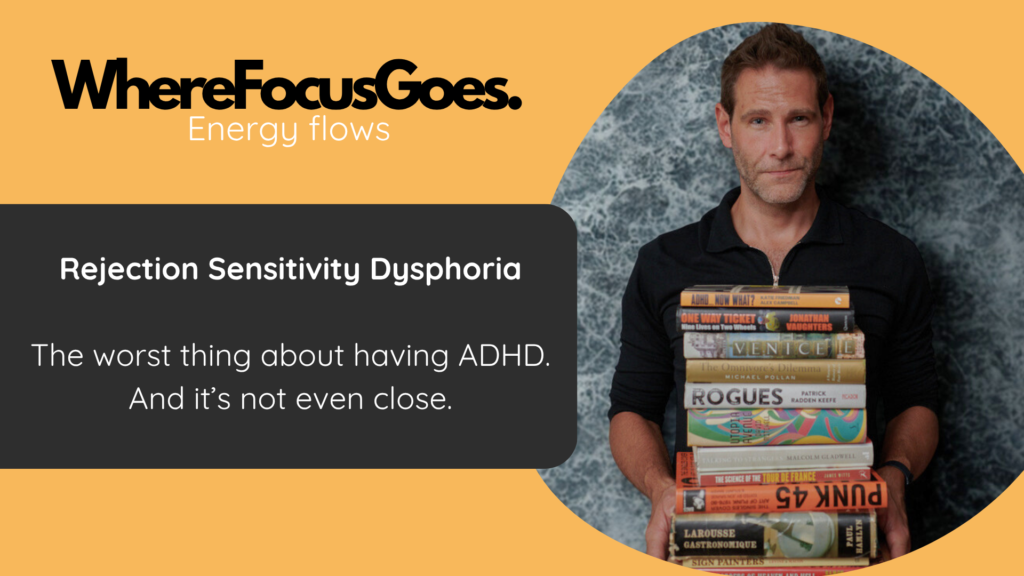
For me though, the most validating part of getting my ADHD diagnosis was finding out about Rejection Sensitivity Dysphoria (RSD).
For years I’d been accused of being too sensitive. For letting things get to me that ‘bit too much’ – and for really struggling with my emotional responses to certain things. Usually this showed up as a nagging, indescribable feeling that something bad is about to happen. That everyone was thinking terrible things about me.
If I spoke up in class, or a meeting and couldn’t quite get my point across (because I was so worried about how my point would land with others, that I would often get flustered and forget what I wanted to say) – I would immediately start an internal narrative that everyone hated me and thought that I was an awful person.
Then, if something real set my emotions off, like being dumped or getting made redundant, it would feel like a sudden physical wound. A cross between a gut punch and being kicked in the crotch. Yes – that painful. And it would last too. Hours, days, sometimes weeks – living with that feeling. It becomes so all encompassing that it settles on top of you. I’d feel it in my chest, in my sinuses, the tops of my ears. I’d tell people I was OK, but inside I felt like I’d been punched, right in my rib cage and a fist gripped tightly around my heart was slowly pulling me downwards.
I’d spoken to doctors and been mis-diagnosed – and medicated – for anxiety and depression at multiple points in my life. But it didn’t sit right with me, because a lot of the time it felt so situational.
So finding out about RSD, seeing my experience repeated back to me – that was when I knew. I knew that was what I’d been living with my entire life. It didn’t make it any easier to live with – not at first – but having a name for it and knowing I wasn’t alone was huge.
But it turns out that working in the creative industries, where everything you do and all the work you produce is judged every second of every day, isn’t such a great thing if you suffer from RSD! Who knew…
And looking into the patterns that us ADHDers tend to fall into when we feel our RSD flaring up, not only do I recognise a lot of myself – but also a lot of the folks I’ve worked with too. The thing with RSD is that our reactions are often not appropriate or proportionate to the trigger. What that usually means for me is that I will either internalise things – collapsing into unbearable shame, worthlessness and depression-like symptoms, or I will externalise my reaction which can look like defensiveness, a sudden need to deflect or distract, or in some cases: anger.
None of which I want for myself. Which led to the most pervasive and insidious side effect: I stopped backing myself, stopped advocating for myself and ultimately, I stopped trying.
Put bluntly: I stopped putting myself in situations where I could be setting myself up for failure.
The Why: what’s happening in your ADHD brain
RSD is not a character flaw or a thin skin. It is a neurological response rooted in how ADHD brains regulate emotion.
The brain’s threat-detection system, the amygdala, responds to perceived rejection or criticism as if it were a genuine emergency. The response is immediate, intense, and largely immune to rational reassessment in the moment. That is why you can know, intellectually, that your reaction is disproportionate. And still not be able to stop it.
This is connected to the same dopaminergic and noradrenergic pathways that affect attention and executive function in ADHD. When those systems are dysregulated, emotional responses don’t just feel bigger. They bypass the parts of the brain that would normally apply the brakes.
The internal and external responses I talked about are the same mechanism playing out in different directions. Both arrive without warning. Both disappear, eventually, as if they were never there. And both leave you having to account for them to people who only saw the surface.
The anticipatory avoidance is the part that does the longest-lasting damage. The brain learns, rationally, that if perceived rejection generates that level of pain, the safest strategy is to remove yourself from situations where rejection is possible. Which is exactly how you end up in the place your essay describes: not backing yourself, not advocating for yourself, not trying. Not because you stopped caring. Because the cost of caring had become too high.
What Can You Do About It
1. You’ve already done the hardest part. Having a name for it changes the relationship you have with it. Not immediately, and not completely. But the shift from “I am too sensitive” to “I have RSD and this is what that means” is genuinely significant. The internal narrative changes. You stop pathologising a character flaw that was never a character flaw.
2. Map your specific triggers. RSD triggers are often more predictable than they feel. For people in creative industries, the common ones are: feedback sessions, award results, pitches lost, anything you put into a room where it will be judged publicly. Knowing yours in advance means you can plan for the aftermath rather than being ambushed by it.
3. Extend the pause. You cannot stop the response. You can, with practice, extend the window between the trigger and what you do with it. A 24-hour rule on strongly-worded emails. A stock phrase that buys you time in a meeting. Physically stepping away from a room for five minutes. None of this eliminates the experience, but the pause is where better decisions get made.
4. Talk to whoever manages your ADHD treatment. RSD sometimes responds to medication. Not always the stimulant medication prescribed for attention, but other options that a prescriber who understands ADHD will know about. If RSD is significantly affecting your daily life and your career, it is worth raising specifically. Name it by name.
5. Stop managing it alone. One trusted person at work who understands what’s happening changes the dynamic considerably. So does working with a coach who understands ADHD and emotional regulation: not just focus and productivity, but the emotional cycles that sit underneath the performance. The isolation of carrying this silently has its own cost, on top of everything else.
If you can recognise yourself in any of this then you know the pain of RSD. It’s so difficult to get others to understand how it feels – so when you know it’s not just a ‘You’ problem, it can feel massive.
You weren’t too sensitive. You were carrying an intensity that the people around you couldn’t see and that you couldn’t explain. And you built a career in one of the most emotionally exposed industries in the world while doing it. Largely alone, largely in silence, largely by stopping trying rather than risking the alternative.
Having the word doesn’t fix it. But it is where the fixing starts. Because you can’t work with something you can’t name. And now you can name it.
I work with ADHDers in advertising, marketing, PR and the wider creative industries. To find out more, take a look at my coaching page.
If you want to work with an ADHD coach who gets it, understands what it feels like and now works with other high performing ADHDers to gain clarity and move past what’s been keeping them stuck – book a discovery call at WhereFocusGoes.com