
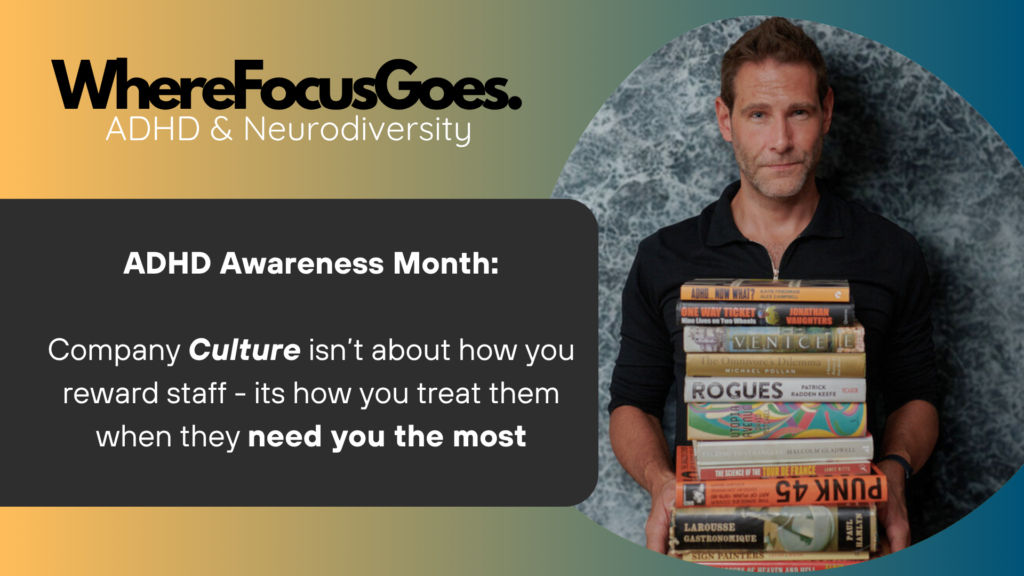
ADHD Awareness Month: Company culture is how you treat your staff when they need you the most
Last week I sat down with Louise Scodie and Katrina Urban from NABS for a piece marking World Mental Health Day, on the theme of lived experience at work. And about how those within positions of power – the power to change and shape organisational culture – can use their lived experience to benefit others.
Naturally my thoughts turned towards how I now use my own lived experience to inform how I work with my coaching clients, run training sessions and rant and rave into the void, on this very blog.
I’m creating a culture. A culture that sees neurodiversity as a net positive. A culture that sees unsupported neurodiversity as untapped performance potential.
But cultures don’t change overnight.
When I disclosed my own diagnosis to my employers nearly 5 years ago it was met with a shrug. I might as well have told them I’d just discovered a new favourite sandwich. Their indifference effectively said: I don’t know why you’re telling me this information. At the time, I wasn’t totally sure I knew what I wanted the response to be. But I did expect more than that.
That was the culture of that company writ large in a single exchange. Not unkind. Not malicious. But assuming that the person making the disclosure should know exactly how to manage the process.
So with ADHD Awareness Month kicking off today, I wanted to write this issue on what culture actually is, why lived experience is the only thing that genuinely builds it, and what you can do about it whether you’re the person disclosing or the person being disclosed to.
What’s Causing This
Here’s the uncomfortable truth about workplace culture: the brilliant spiel you give to new joiners about how you’re all ‘family’, the Friday drinks trolley, even the company away days: none of it matters.
If a colleague confides in you that they disclosed a condition, or asked for tailored support and nothing changed – that reinforces the belief that the company ‘culture’ is just based on what is currently convenient and aligns nicely with the status quo.
Culture is a pattern of tiny, repeated signals, not a single grand gesture. A policy can say your organisation supports neurodivergent staff. But if the lived experience of disclosing doesn’t match the policy, a panicked line manager, a shrug, silence, then the policy is just lip service and what starts to grow in the space of where the support should be is not the kind of culture you want in your organisation.
This matters more than it sounds, because our role as leaders, change makers, dare I say it: influencers (cringes self to death) isn’t to fix people, it’s to create an environment where people feel supported and can access the right resources.
Those are two completely different skills. Fixing is reactive, often unwelcome and removes the agency from the individual seeking the change. Building a culture that truly walks-the-walk means genuinely supporting people. Helping them access the right support at the right time and enabling them to thrive in a system that’s built to accommodate difference.
There’s a bigger point here too, one that’s easy to miss: everyone’s lived experience of the same condition is different. I have ADHD. That doesn’t mean another person with ADHD experiences it the way I do. The trap leaders fall into is treating people how they themselves would want to be treated, rather than staying curious about the specific person in front of them. That’s not empathy. That’s rescuer / fixer behaviour and no matter how well intended, is not the right solution.
And here’s why it matters so much. Because it CAN get easier through culture. But that cultural change has to start with giving people the right tools and creating the right conditions for success. Right now, most workplaces are an environment where the cost of disclosing is still higher than the cost of hiding. But I do believe a tipping point is near.
What You Can Do About It
If you’re the one carrying the lived experience:
You don’t owe your employer a fully formed support plan the moment you disclose. If your honest answer to “what do you need?” is “I’m still working that out,” that’s an acceptable answer. Say it anyway.
Don’t mistake a shrug for a verdict on your worth either. Indifference from one manager, one company, one moment, tells you something about that culture, not about whether your diagnosis matters. Some people and companies will get it. Don’t lose heart if yours isn’t there yet.
If you’re in a position to talk about your own experience, even informally, do it. Tipping points aren’t caused by one dramatic policy change. They’re caused by enough individual disclosures, enough honest conversations, that indifference stops being the easy option.
If you’re the one leading, managing, or building the culture:
Notice what happens in the thirty seconds after someone discloses something about themselves. That reaction, not your values deck, is the culture your team actually experiences.
Stop treating disclosure as a problem to be solved on the spot. A panicked scramble for “the right response” is just as damaging as a shrug, because both tell the person their disclosure created a problem rather than helped them feel at ease.
If someone discloses or asks you for support and nothing about their day-to-day actually shifts, everyone watching learns the same lesson: speaking up doesn’t move anything. That lesson spreads far faster than any policy document.
Build the conditions before you need them, not in response to the first disclosure that catches you off guard. Waiting until someone’s in front of you is how you end up defaulting to a shrug or a panic. Neither is a strategy.
The workplace neurodiversity training I offer through WhereFocusGoes was designed to give leaders, managers and HR teams the awareness and understanding, the value of my lived experience, so they can make the necessary changes to their policies, their ‘corporate values’ and their company culture before it has the potential to cause a problem.
With ADHD Awareness Month starting today, there’s genuinely no better moment to get in touch and talk about what that could look like for your team.
Tipping points don’t arrive on their own. They arrive because enough people, on both sides of that thirty-second exchange, decided to do something differently. That’s the bit within your control, starting now.