
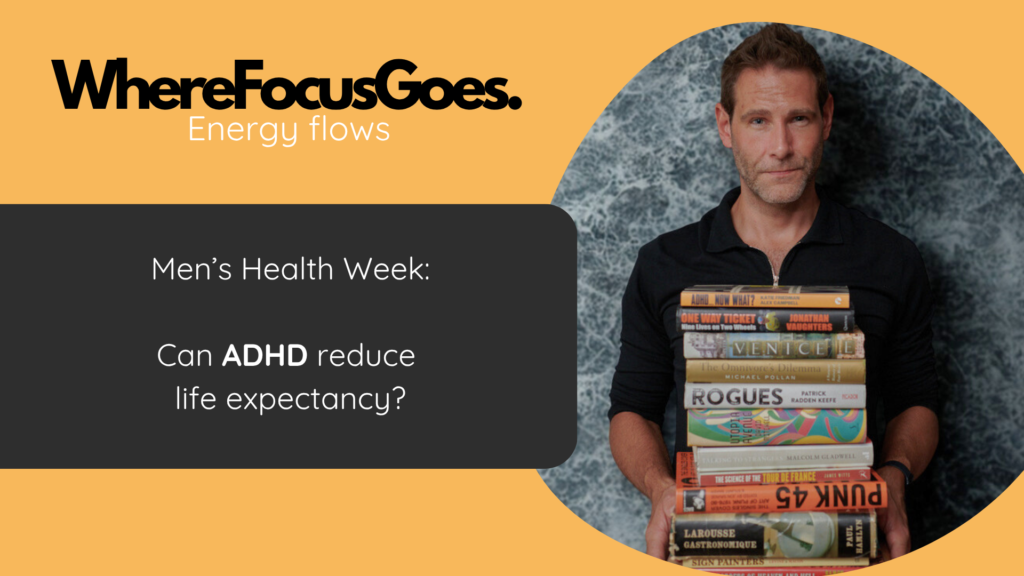
If you’re a man with ADHD, you’re probably going to live between 4.5 and 9 years less than a man without ADHD.
That’s the same as being a smoker, and worse than being a heavy drinker.
If that doesn’t shock you, try this one on for size: Adults (men and women) with ADHD are FIVE TIMES more likely to attempt suicide than those without.
Now, as someone with ADHD, who is both a former heavy drinker and smoker AND a survivor of suicide… I have some thoughts.
And honestly, my thoughts begin at ‘how can this be so cruel’ – continue towards ‘why are we not doing more about this’ – and then usually trail off into a pit of despair. I’ve spoken before [Here] about how my own diagnosis was a watershed moment for me. Having been mis-diagnosed with anxiety and depression in my teens, twenties and thirties, finding out that my ADHD was why I felt things so acutely, why I was a walking ying yang of chaos and brilliance, and why I struggled and held shame so deeply – was like feeling seen for the first time. It didn’t make the chaos disappear, didn’t suddenly turn me into Captain Neurotypical – but instead offered a sudden, visceral ability to see myself, bone deep.
Not everything made sense, not at first and not even now. Maybe life isn’t really supposed to make sense. I mean, how else would you explain… [gestures towards everything, currently on fire]
But it offered clarity. Perhaps a glimpse of clarity at first – but after a lifetime spent feeling like an actor horribly mis-cast in the wrong role – that small slither of truth was intoxicating. I had to have more of it. I ran towards it and it saved me.
I have one more statistic for you: Fewer than 1 in 9 adults with ADHD have been diagnosed.
Imagine – for every one person like me there are 8 more who continue to live with that feeling of not being enough. Perhaps being misdiagnosed with anxiety and fobbed off with some mild antidepressants. Feeling like they’re constantly at odds with the world. All that anger, frustration, loneliness, despair – I know it well. I wore them all beneath the suit of armour I’d put on before stepping out into the world. It weighed me down so much that just carrying it all day, every day took up so much energy I could barely spare any to steer my own life in the direction I wanted.
Diagnosis was the permission I needed to take off all those layers of shame and start moving in a more positive direction. One foot in front of the other, gradually, slowly and surely.
And honestly, it feels fucking great. And it started with KNOWING.
So let’s spread the word.
The Why: what’s happening in your ADHD brain
The life expectancy gap isn’t random, and the suicide risk isn’t coincidence. There are specific things happening in the ADHD brain that make these numbers real.
Your ADHD brain runs on a dopamine deficit. Not a motivation deficit, a neurological one. Healthy habits like exercise, regular meals, booking a GP appointment, taking medication consistently, don’t produce the same reward signal they do for neurotypical brains. This isn’t weakness. It’s why maintaining a gym routine or eating consistently healthy meals feels disproportionately hard. The feedback loop that sustains healthy behaviour isn’t firing the way it should.
On top of that we need to address our Executive Functions – or Executive Dysfunction, which is the root of much of the friction we feel operating in a world built for neurotypicals. Looking after your health requires exactly the skills that ADHD undermines: planning, initiation, follow-through. Booking appointments. Opening, reading and filing away hospital letters. Remembering to chase test results. When your prefrontal cortex isn’t running optimally, those tasks don’t get done. It’s not that you don’t care. It’s that the system of healthcare wasn’t built for an ADHD brain.
Add to that the physical cost of chronic disregulation. The ADHD nervous system operates in a near-permanent state of elevated stress. Cortisol runs high. Sleep gets disrupted. Cardiovascular strain compounds, silently week after week, month after month. Years of unmanaged ADHD stress leaves marks on the body that eventually show up in the statistics.
And for men specifically, all of this is compounded by our most dangerous and prevalent trait: not asking for help. Research published in 2024 found that men with ADHD are especially likely to internalise negative feelings about their condition and disengage from help-seeking. The people most at risk are the least likely to seek support. That is the loop we need to break.
What Can You Do About It
- Get diagnosed and treated. This is the most direct lever available. A Swedish study found that ADHD medication reduces mortality risk by 19%. It also improves adherence to other health treatments by up to 50%. Treating your ADHD isn’t just about focus. It could literally be a life-extending intervention.
- Build external systems for health admin. Don’t rely on memory or good intentions. Recurring calendar reminders for appointments and medication. Automated repeat prescriptions. A tracking app you actually use. The goal is to make looking after yourself as friction-free as possible, because friction is where ADHD wins.
- Find a GP who understands ADHD, or brief the one you have. Many GPs still treat ADHD as a childhood condition. Being understood by your healthcare team changes everything from how appointments are run to what support is offered.
- Treat exercise as medicine, not motivation. Regular aerobic exercise is one of the most evidence-based interventions for ADHD. It increases dopamine and norepinephrine, reduces cardiovascular risk, and improves sleep. If you don’t enjoy one form of exercise, find one you do like. It took me until 35 to realise I really liked cycling. Don’t wait as long as me!
- Tell someone. One person. A partner, a friend, a colleague, a coach, a GP. Men with ADHD face a documented double stigma and the research is unambiguous: isolation makes outcomes worse. The act of telling one person breaks the loop. It doesn’t have to be a dramatic conversation. It just has to happen.
Sources:
- Life expectancy gap (4.5-9 years for men): British Journal of Psychiatry, UCL
- ADHD Evidence — Meta-analysis on suicidal behaviour in ADHD
- CHADD — ADHD Can Increase Risk of Suicide
- Fewer than 1 in 9 diagnosed: same UCL/BJPsych study above
- Men with ADHD and help-seeking stigma (2024): ResearchGate
- Medication reducing mortality by 19%: Psychiatry Advisor
- Medication improving treatment adherence: Psychology Today