
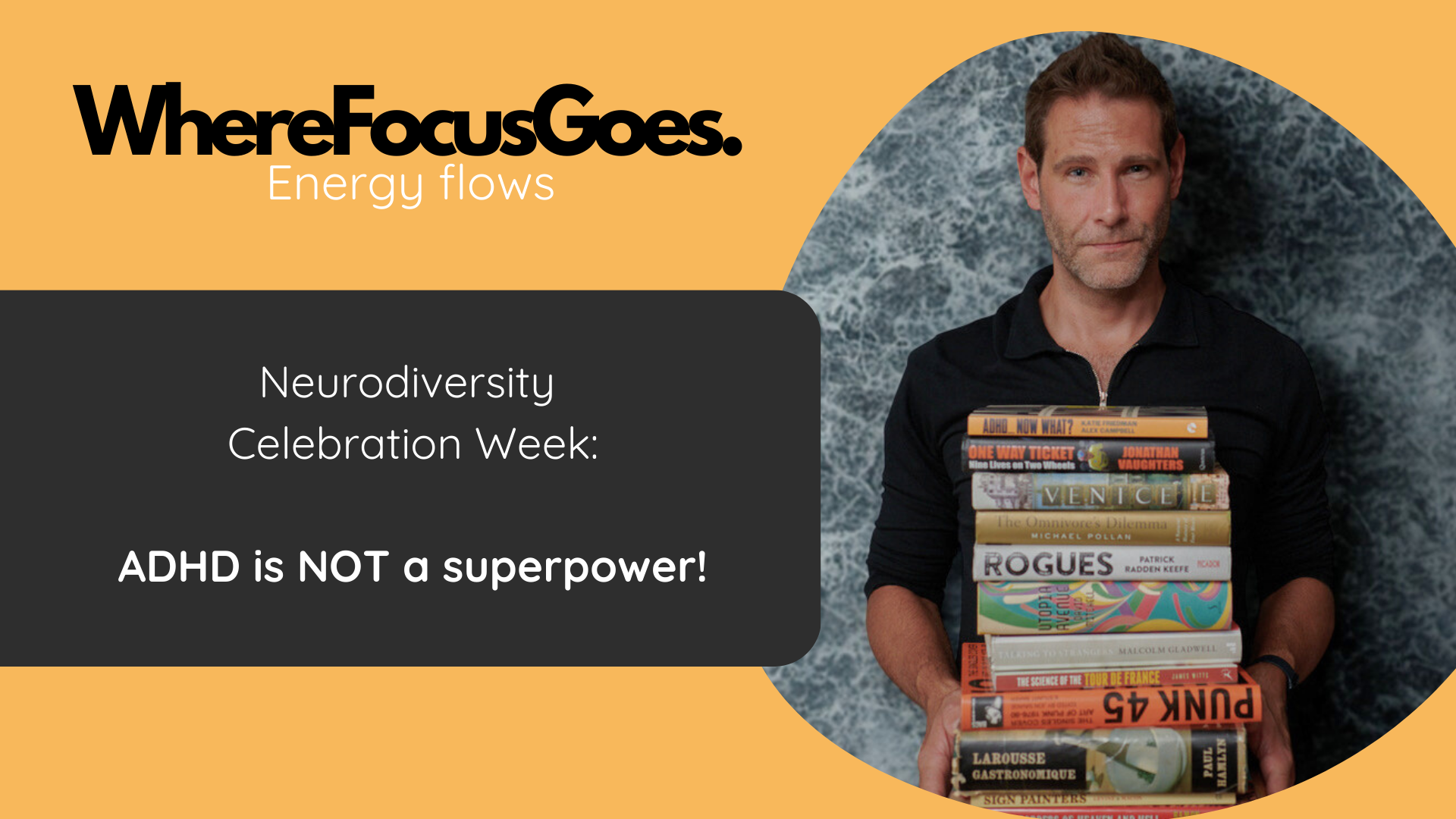
Neurodiversity Celebration Week
Somewhere right now there’s a LinkedIn post going up about how ADHD is a superpower.
There’s a graphic. There’s probably a motivational quote. There might be a rainbow.
And to be very honest with you: it makes me cringe so hard I worry I might actually turn inside out.
Not because I don’t believe there’s something worth celebrating in neurodiversity – I do, genuinely. But “ADHD is a superpower!” is easy to say and hard to live with. Especially on the days you’ve missed a deadline, forgotten an important conversation, or sat staring at your phone for two hours while the rest of the world just… got on with it.
So this isn’t that kind of celebration.
THE BIT THEY DON’T PUT ON THE GRAPHIC
I ran a video production agency as Managing Director for nine years. We worked with some of the world’s biggest brands. We were regularly asked to deliver complex, high-stakes projects, on tight deadlines, with limited resources. And we did it. Consistently.
What I didn’t know at the time was: my ADHD was doing a significant amount of the heavy lifting.
The hyperfocus that locked in when the stakes were high. The pattern recognition that helped me find creative solutions before anyone else in the room had spotted the problem. The stimulation-seeking that meant chaos didn’t scare me, it gave me something to feed off. The willingness to take risks that looked reckless from the outside but felt, to me, like the only sensible move.
I could not have built that career without those traits.
THE CATCH
Those same traits were a nightmare in the wrong context.
When there was no deadline and the work was tedious? I was useless. Admin piled up. Emails went unanswered. I forgot things. Disappointed people in small, grinding, chronic ways.
The traits that made me exceptional in the right conditions made me unreliable in others.
This is why the “superpower” framing bothers me. It suggests the traits are uniformly brilliant when really, they’re contextually brilliant. And the gap between those two things is where a lot of ADHDers suffer in silence, confused about why they’re sometimes exceptional and sometimes absolutely, bewilderingly not.
LEANING IN IS A STRATEGY, NOT A VIBE
After my diagnosis at 40, and especially after the burnout and mental health breakdown that followed shortly after, the thing that changed everything wasn’t finally accepting that my brain was “different” or “special.”
It was understanding precisely how it worked. And then designing my life accordingly.
Hyperfocus is only useful if you have interesting work to point it at. Interest-based motivation only fires if you know what lights your brain up. High-stimulation-seeking is an asset in a fast-paced creative environment (and a liability if you’re trying to do quiet, repetitive work in a silent office).
Leaning in to your neurodivergent traits isn’t about deciding they’re great and hoping for the best.
It’s about:
- Knowing which traits you actually have (not the ones you think you have, because every ADHDer is different)
- Understanding what conditions allow those traits to work for you
- Deliberately putting yourself in those conditions where you can
- And building systems and support for the rest
That’s not a superpower. That’s self-advocacy.
THE TRAITS THAT BUILT WHEREFOCUSGOES
After the burnout, I left a 20-year career and started again from scratch. On paper, that looks like a bold, courageous decision.
In reality, it was also a very ADHD one.
The risk tolerance that makes ADHDers seem reckless? I leaned into it. The deep interest and motivation that comes when you’ve found work that genuinely matters to you? I built my coaching practice around it. The pattern recognition and creative thinking that had fuelled a career in the creative industries? I redirected it into building something new.
I also leaned into something less talked about: the empathy that comes from lived experience. I’ve been that person sitting across from a GP who doesn’t understand ADHD. I’ve been the one who nailed the impossible brief and then forgot to invoice for it. I understand both the frustration and the capability, because I’ve lived both, usually in the same week.
WhereFocusGoes exists because I leaned in. Not because ADHD is a superpower. But because, once I understood the machine I was operating, I could finally build a life where it worked more than it didn’t.
WHAT I’M ACTUALLY CELEBRATING THIS WEEK
I’m celebrating that I finally understand how my brain works.
After 40 years of wondering why I could manage chaos and complexity with ease but fall apart trying to do basic admin.
I have an answer. Not a comfortable one, not a simple one, but a real one.
The diagnosis didn’t fix anything. But the self-knowledge – the deliberate, hard-won understanding of which traits I have, what conditions they need, and where the edges are?
That’s what changed everything.
That’s what I’m celebrating.
💡 One thing to try this week
Pick one trait you’ve been fighting — something about how your brain works that you’ve spent energy suppressing, apologising for, or trying to override.
Now ask: in what environment do those neurodivergent traits become useful? Where does neurodiversity become an asset rather than a liability?
You don’t have to change who you are. You might just need to change where you are.
This week’s resource
If you’re trying to build a better understanding of how your ADHD brain actually works (and what to do with that knowledge practically) my free ADHD & Mental Fitness Playbook is a good place to start. Sleep, focus, movement, regulation: the toolkit I wish I’d had when I was first putting this all together.
Download it free at wherefocusgoes.com.
And if the idea of having someone help you work out which traits to lean into, and how sounds useful, a free 30-minute discovery call is a good first step. No pressure, no pitch. Just a conversation.
Book one at wherefocusgoes.com.